
Your supply chain is more fragile than you think…
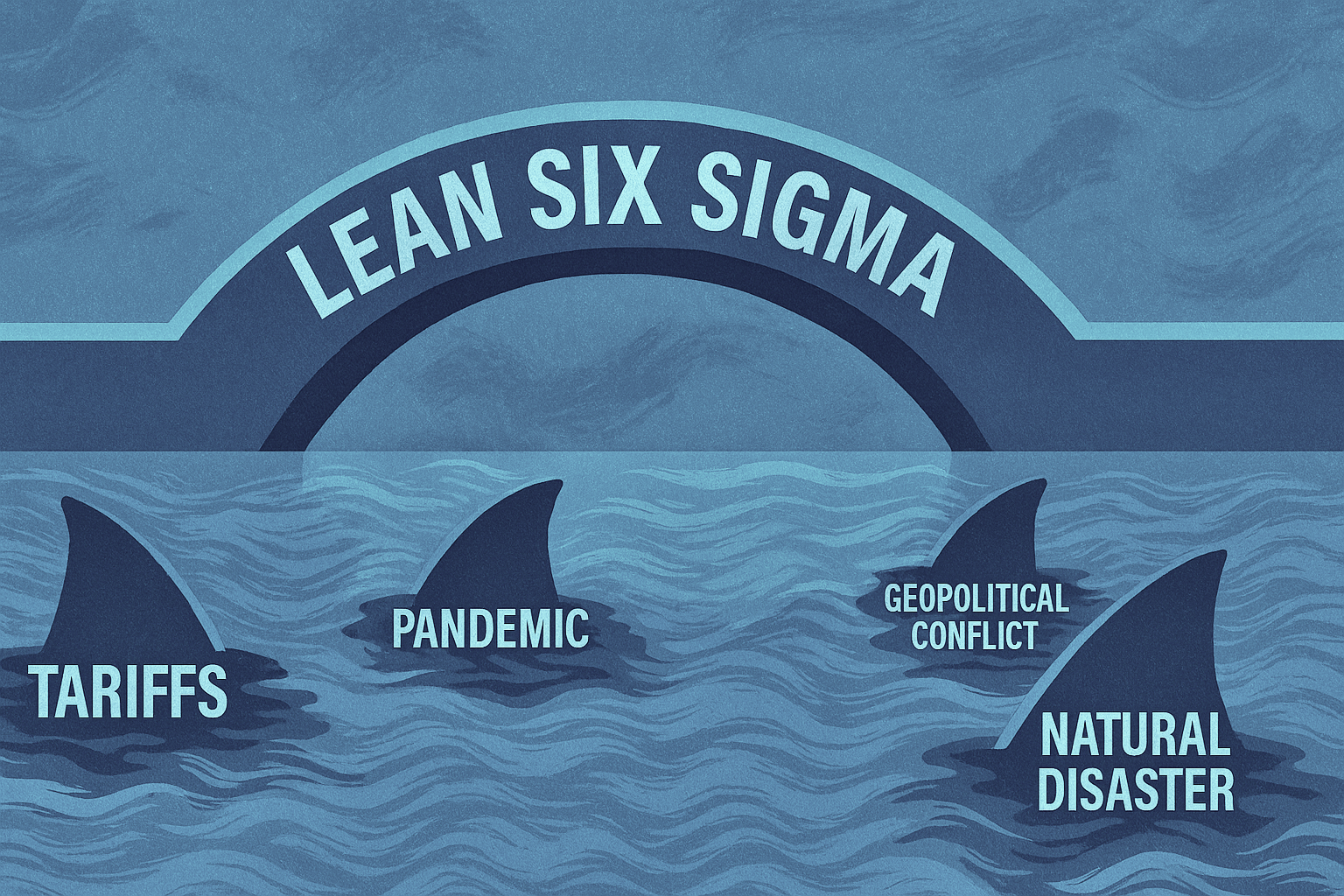
Most supply chains are optimized for efficiency — not resilience. And that is a dangerous mistake.
Just look at the last 5 years:
The pandemic caused lead times to double—or worse.
Geopolitical conflicts disrupted entire trade lanes overnight.
Tariffs sent costs skyrocketing.
Natural disasters wiped out supplier capacity in days.
The question isn’t if the next disruption will occur — it’s when. And when it does, will your operations bend or break?
Why Traditional Responses Fail
When disruption hits, many organizations fall into predictable — but dangerous — patterns:
The Hoarder – Panic-buying everything in sight. Warehouses overflow, cash dries up, and excess inventory becomes obsolete.
The Freezer – Slamming on the brakes. Orders are paused while leaders “wait it out,” leaving customers stranded and competitors taking market share.
Both reactions are driven by fear, not discipline. True resilience is not created by panic. It is created by process.
The Lean Six Sigma Difference
Resilient organizations don’t rely on luck. They rely on an operating system.
Across manufacturing, healthcare, logistics, and technology, Lean Six Sigma has proven to be one of the most effective frameworks for building resilience under volatility. It equips organizations with data-driven problem-solving tools that strengthen supply chains instead of destabilizing them.
This isn’t about more inventory or less — it’s about right inventory.
It isn’t about pushing suppliers harder — it’s about systematically improving performance.
True resilience is not redundancy. Redundancy is expensive insurance.
Resilience is a capability — built through visibility, control, and fast decision cycles.
Done well, Lean Six Sigma turns uncertainty into competitive advantage.
Measurable Results with Lean Six Sigma
Based on benchmark studies and field results from global Lean Six Sigma deployments, organizations routinely achieve:
Forecast Accuracy: 40–60% improvement in reliability
Inventory Optimization: 25–30% reduction in carrying costs while maintaining service levels
Supplier Quality: 50% fewer defects through structured root-cause elimination
Response Agility: 75% faster adaptation to major supply disruptions
These are not theoretical gains. They are operational results observed across:
Manufacturing – Stable material flows despite tariff volatility
Healthcare – Reliable availability of critical equipment during global shortages
Hospitality – Consistent service levels through supplier diversification and process control
Five Lean Six Sigma Strategies for Supply Chain Resilience
1. Improve Demand Forecasting with Data Discipline
Outcome: Reduce volatility, not just error.
Using DMAIC, organizations identify the true drivers of forecast inaccuracy — poor data quality, biased assumptions, or disconnected systems. Regression analysis and time-series modeling replace intuition with evidence, improving confidence and stability.
Example: A consumer electronics company reduced backorders by 35% during demand spikes.
2. Right-Size Inventory with Value Stream Mapping
Outcome: Protect service while freeing working capital.
Value Stream Mapping exposes hidden queues, delays, and buffers. Kanban and pull systems place inventory where it creates value — not where it merely feels safe.
Example: A logistics firm cut carrying costs by 28% and released cash to absorb tariff shocks.
3. Strengthen Supplier Performance Through Six Sigma Quality
Outcome: Fewer surprises, fewer disruptions.
Supplier scorecards, Pareto analysis, and root-cause investigation eliminate chronic defects and late deliveries instead of firefighting symptoms.
Example: A hospital system reduced supplier-driven stockouts by 60% during global shortages.
4. Build Agility Through Standardization and Scenario Planning
Outcome: Fast pivots instead of slow reactions.
Standard work and “what-if” simulations create playbooks for port closures, labor strikes, and geopolitical events before they happen.
Example: An automotive supplier shifted 40% of production to alternate sources within weeks of a geopolitical disruption.
5. Embed Continuous Improvement for Long-Term Resilience
Outcome: A system that gets stronger after every shock.
Kaizen, FMEA, and capability building ensure resilience compounds over time instead of eroding.
Example: A hospitality chain’s quarterly Kaizen events delivered millions in cumulative supply-cost savings.
Why Resilience Now Defines Competitive Advantage
In today’s world, supply chains are not just pipelines of product; they are lifelines of competitiveness.
Organizations that thrive through disruption share three traits:
Predictive Insight – They see risk forming before it explodes.
Operational Discipline – They respond with precision, not panic.
Continuous Adaptation – They improve faster than uncertainty evolves.
Lean Six Sigma is the engine behind all three.
Don’t Just Survive — Design for Uncertainty
The next disruption is not a possibility — it is a certainty. Whether driven by geopolitics, climate events, labor constraints, or policy shifts, volatility is now structural — not cyclical.
If you are responsible for supply chain performance, operational resilience, or enterprise risk, now is the time to move from reaction to design.
If your organization is interested in:
Building a structured resilience roadmap
Equipping leaders and teams with practical Lean Six Sigma tools
Developing internal capability to anticipate, absorb, and adapt to disruption
I invite you to contact me directly to discuss how our Lean Six Sigma training and certification programs can help you embed resilience into your supply chain operating model.